When Was the Paid Family and Medical Leave
Universal Paid Family unit and Medical Leave Nether Consideration in Congress
The House of Representatives is considering a provision of the Build Back Better Act that would create a universal paid family and medical leave programme. This mail takes a look at this proposal, key policy questions, and what information technology could hateful for women and families.
What is in the proposal?
Effective July 2023, the proposal would guarantee 12 weeks of paid family and medical leave annually to all workers in the U.S., including those working for private employers, country, local, and federal governments, likewise as self-employed and gig workers. Workers would exist covered through either the new federal program or a qualified existing employer or state paid leave plan. The proposal would supercede 85% of wages for earnings up to $290 per week ($15,080 annually), plus 75% of average weekly earnings betwixt $290 and $659, plus 55% of average weekly earnings between $659 and $1,385, plus 25% of average weekly earnings between $1,385 and $i,923, plus five% of average weekly earnings between $1,923 and $iv,808 (about $250,000 annually).
Qualifying reasons for leave include:
- Welcoming a new child by birth, adoption, or foster intendance.
- Recovering from a serious illness.
- Caring for a seriously ill family unit member (by blood or affinity)
- Addressing issues arising from a loved one's armed services deployment or serious injury.
What family unit members could workers take go out to treat?
- Spouses, parents and guardians, and children.
- Siblings, grandparents, and grandchildren; in-laws; and whatsoever other association by blood or analogousness that is equivalent to a family human relationship.
The proposal as well allows for three days of paid bereavement leave following the death of an firsthand family member. There is currently no national bereavement get out policy.
What does the status quo look like?
The U.S. is the simply industrialized nation without a minimum standard of paid family or medical get out, even though universal paid exit enjoys strong public support, including amid Republicans. Nine states and DC have paid leave requirements and some employers voluntarily offer these benefits, resulting in a patchwork of policies with varying degrees of generosity. The federal Family and Medical Exit Act (FMLA) requires some employers to provide unpaid time off as well as job protection to eligible employees for family caregiving and medical leave, but just over one-half (56%) of the workforce is eligible.
Nigh people will need to take fourth dimension off piece of work to treat themselves or their families at some indicate, but only about one in four (23%) workers have access to paid family unit leave through their employer. That share is even lower for depression-wage and part-time workers, and in certain occupations (Figure one). Information on the share of workers with access to paid medical leave for a longer, serious illness are limited, although 40% of workers are estimated to have access to short-term disability insurance.
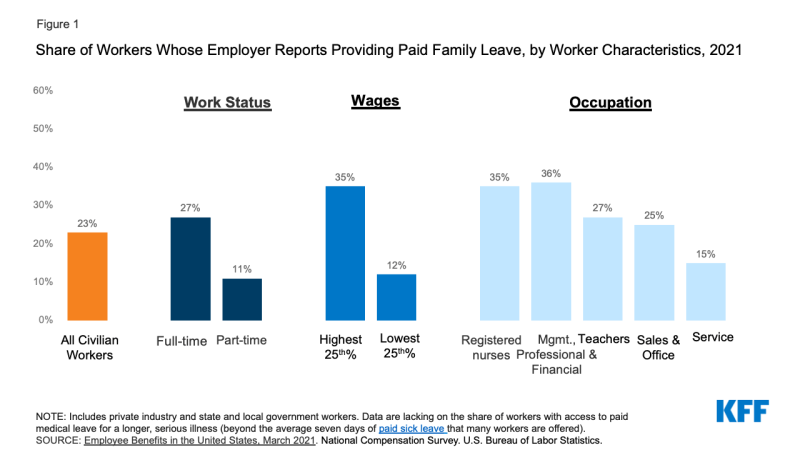
Effigy one: Share of Workers Whose Employer Reports Providing Paid Family Leave, by Worker Characteristics, 2021
How would this proposal intersect with existing state-level and voluntary employer paid exit programs?
The proposed federal bill would allow existing programs to remain so long as they're at least equally comprehensive as the federal program. However, it would apply to a broader range of workers than many employer programs or any of the state-level laws, suggesting that modifications to existing programs could be needed should the federal bill be enacted.
What is the process for Congressional approval?
The Build Dorsum Better Deed is being considered through the budget reconciliation process. Passage would require almost all Democrats in the Firm and all Democrats in the Senate to vote for information technology.
Some Senators (Republicans and some conservative Democrats) have expressed concern about the overall toll of the budget resolution. While the current version of the entire legislative package is estimated to cost nigh $three.v trillion over ten years, it is unclear how the paid exit program, specifically, would be financed and the Congressional Budget Function (CBO) has non scored it. If the toll of the electric current budget resolution gets reduced during Congressional negotiations, the scope of the paid go out provision could be scaled back.
Senate Democrats have not released a recent paid go out proposal but could accept upwardly the House bill in its current form or look to elements of other proposals. For example, the paid family and medical leave proposed as part of President Biden's American Families Plan would cover nearly all workers, would have a $four,000/month cap on wage replacement, and would be financed through full general taxes, but information technology as well has not been scored by the CBO. Unlike the Firm proposal, in Biden'south plan, total benefits would not exist realized until year ten of the programme. In 2019, the CBO estimated that the Autonomous-led FAMILY Human activity, like to Biden'southward proposal, merely partially paid for by a new payroll taxation, would price $547 billion over x years.
What would universal paid go out hateful for women and families?
Paid leave is particularly important for women, who are typically the primary caregivers in families, and is associated with improved mental and physical wellness for new mothers and infants. Research has also constitute that access to paid family leave helps women remain in the workforce after giving nativity.
Additionally, research suggests that under this new proposal, the average American worker taking 12 weeks of paid exit would receive most $nine,000 of pay.
Enacting universal paid family and medical exit would mean increased federal spending, but would have tangible wellness and economic benefits for workers and families when they need to accept an extended leave for caregiving and medical reasons.
Source: https://www.kff.org/policy-watch/universal-paid-family-medical-leave-under-consideration-congress/
0 Response to "When Was the Paid Family and Medical Leave"
ارسال یک نظر